
Download Template


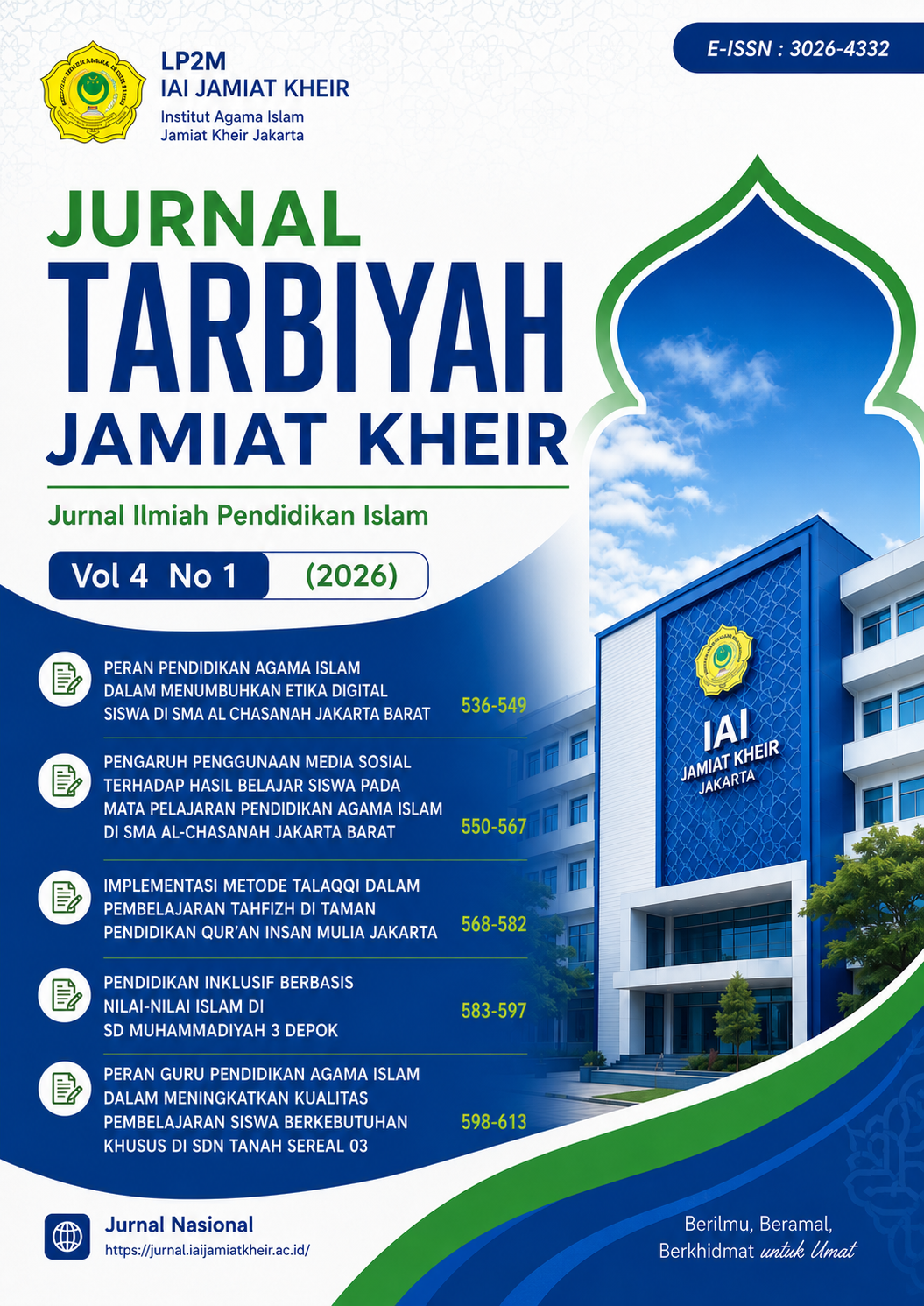
Jurnal Tarbiyah Jamiat Kheir, Volume 4, Number 1 (2026), presents five scholarly articles addressing contemporary issues in Islamic education in Indonesia. This edition highlights the role of Islamic education not only as a means of knowledge transmission but also as a foundation for character development, moral cultivation, competency enhancement, and the implementation of educational practices that respond to the challenges of the digital era.
The first article examines the role of Islamic Religious Education in fostering students' digital ethics, a topic of increasing significance in today's technology-driven society. The study emphasizes the importance of integrating Islamic values into students' digital behavior, enabling them to utilize information technology responsibly, ethically, and in accordance with Islamic moral principles.
The second article explores the influence of social media use on students' learning outcomes in Islamic Religious Education. This study provides insights into the relationship between students' social media engagement and their academic achievement while offering valuable recommendations for educators to optimize digital platforms as effective learning resources.
The third article discusses the implementation of the Talaqqi method in Qur'anic memorization (Tahfizh) learning. The findings demonstrate that the Talaqqi approach remains highly relevant in preserving the quality of Qur'anic memorization, ensuring accurate recitation, and strengthening the educational relationship between teachers and students within the Islamic learning tradition.
The fourth article focuses on the implementation of inclusive education based on Islamic values in an elementary school setting. It illustrates how the Islamic principles of justice, compassion, and respect for human dignity can serve as a strong foundation for developing inclusive educational environments that accommodate students with diverse learning needs.
The final article investigates the role of Islamic Religious Education teachers in improving the quality of learning for students with special needs. The study highlights the importance of teachers' pedagogical competence, professionalism, and exemplary character in creating effective, inclusive, and student-centered learning experiences.
Collectively, the five articles featured in this issue demonstrate that Islamic education continues to evolve as an academic discipline capable of responding to social transformation, technological advancement, and the changing needs of contemporary society. The studies presented contribute both theoretically and practically to the advancement of Islamic education across various educational institutions.
The Editorial Board hopes that this issue will serve as a valuable academic reference for lecturers, teachers, researchers, students, and practitioners in the field of Islamic education, encouraging further research and innovation toward developing high-quality, inclusive, character-based, and future-oriented educational practices.
Happy reading, and may this publication provide meaningful academic contributions to the advancement of Islamic education.
Editorial Board
Jurnal Tarbiyah Jamiat Kheir
Volume 4, Number 1 (2026)
Download Template